
The Apitronix Architecture: Determinism at Scale
The Problem: The Real-Time "Wall"
Traditional automotive and industrial processors are hitting a complexity wall. As the industry transitions toward Software-Defined Vehicles (SDV), the challenge of ensuring that safety-critical tasks (like braking or steering) aren't interrupted by non-critical software (like infotainment or gateway services) has become a nightmare.
Current solutions rely on software-based isolation—Hypervisors and Memory Protection Units (MPUs)—which introduce:
- Significant Latency
- 15–30% performance overhead.
- Unpredictable Jitter
- Interrupt-driven architectures create "Black Box" timing issues.
- Complex Safety Cases
- Proving "Freedom-from-Interference" in software is incredibly costly and time-consuming.
The Solution: Massively Parallel Tasklet Processors
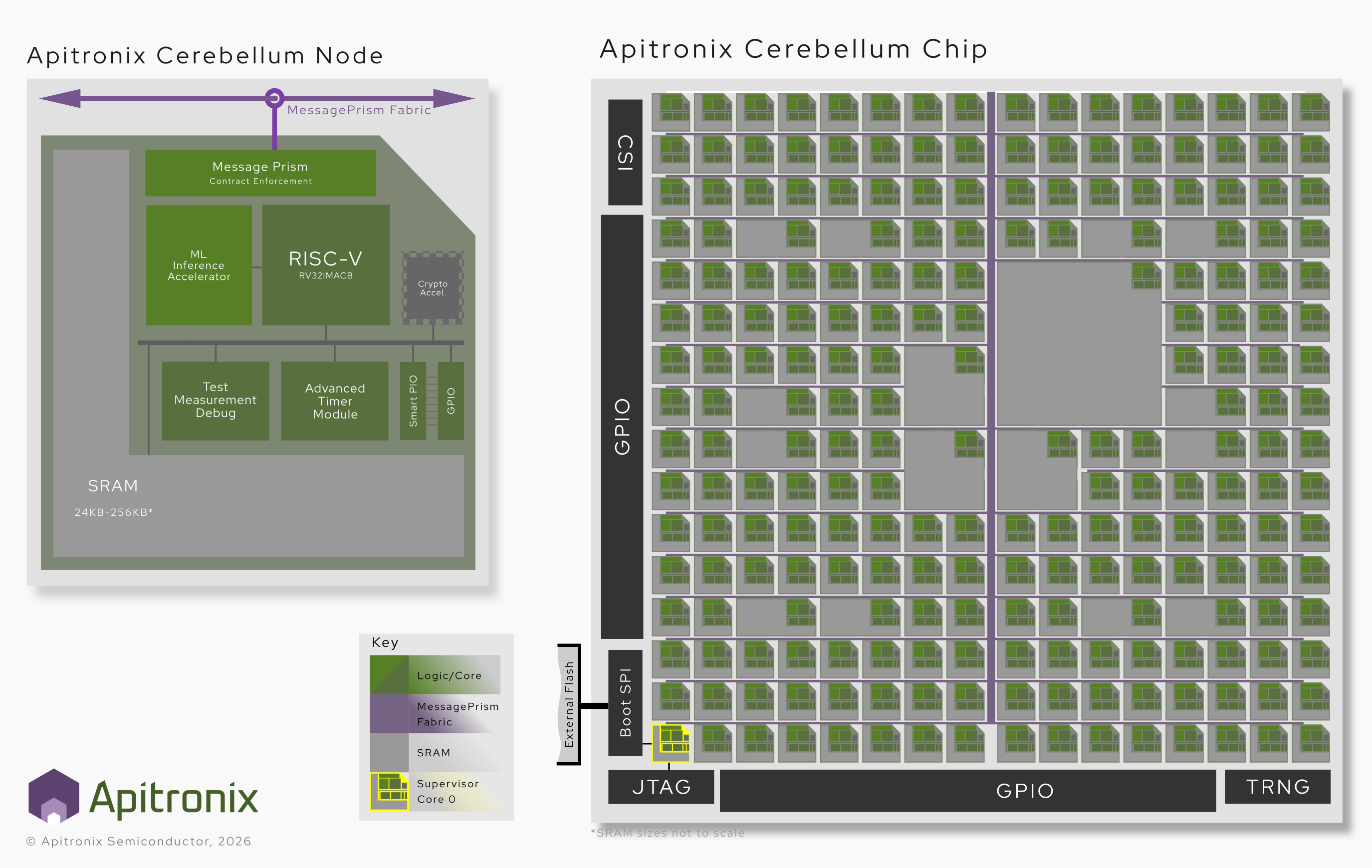
Apitronix reimagines silicon for the real-time era. We replace a few high-frequency, complex cores with a massively parallel array of 220 RISC-V Tasklet Processors™. By moving scheduling and protection from the software layer into the hardware silicon, we achieve a level of determinism that is physically impossible on traditional architectures.
Core Features
Hardware-Enforced Freedom-from-Interference (FFI)
Unlike traditional MCUs, Apitronix enforces isolation at the metal layer.
* True Composability: Run mixed-criticality code (ASIL D and QM) on the same silicon without risk.
* Physical Partitioning: A software failure or infinite loop on one core cannot consume the cycles or access the data of another.
* Zero Overhead: Achieve strict partitioning without the performance tax of a software hypervisor.
The 220-Core Array & Messaging Fabric
The heart of our chip is an array of 220 individual RISC-V cores linked by a proprietary, ultra-low-latency messaging fabric.
* Performance: Delivers 465,700 CoreMark™, approximately 19x the performance of current leading automotive microcontrollers.
* Bounded Latency: Every instruction execution time is constant. There is no jitter from branch predictors or complex cache hierarchies.
* Simulink Native: Our toolchain allows for the direct execution of Simulink models, reducing manual code optimization and cutting development time by up to 12 months.
Deterministic AI & ML Inference
Apitronix brings Machine Learning to safety-critical domains where traditional GPUs often fail due to non-deterministic behavior.
* Consistent Throughput: We offer high-performance ML inference with guaranteed latency.
* The Benchmark: Matches the inference performance of industry leaders like NVIDIA Orin AGX for specific automotive perception tasks, but with hard real-time hardware guarantees.
Comparison: Apitronix vs. Traditional MCU
| Feature | Traditional High-Perf MCU | Apitronix Tasklet Processor™ |
|---|---|---|
| Architecture | 4–8 Complex Cores | 220 Parallel RISC-V Cores |
| Isolation | Software (Hypervisor/MPU) | Hardware (Physical Partitioning) |
| Jitter | High (Cache/Interrupt driven) | Zero (Deterministic Bus) |
| Development | Manual C-code Optimization | Native Simulink/Model-Based |
| Integration | Multiple ECUs (Complex Wiring) | Zone/centralised real-time compute |
Standards & Compliance
Designed for the most rigorous environments, our architecture meets global safety and security requirements:
* Functional Safety: Architected for ISO 26262 ASIL D compliance.
* Cybersecurity: ISO/SAE 21434 ready with hardware-encrypted secure boot.
* Reliability: AEC-Q100 Grade 0/1 qualification.
* Legacy Support: Native support for AUTOSAR peripherals without the software stack overhead.
Engineering the Future of Real-Time
The Apitronix Architecture isn't just a chip; it’s a new philosophy for safety-critical computing. By simplifying the hardware, we simplify the safety case, letting your engineers focus on features rather than troubleshooting interference.